
Debt Declines – But the Burden Falls on the People – Fitch Warns on 2027 Budget
Can the Economy Be Built by Meeting IMF Targets Alone..?
Advertisement
The Hidden Risks in Sri Lanka’s Debt Crisis..!
41% of Revenue Goes to Interest Payments – Sri Lanka Still Has No Breathing Space Despite Moving Forward on the Debt Path
(Sujith Mangala De Silva)
Meeting IMF targets alone will not bring Sri Lanka’s economic crisis to an end. Even as the debt ratio declines, the fact that a substantial share of government revenue continues to be spent on interest payments raises serious questions about the country’s financial independence and its capacity for development.
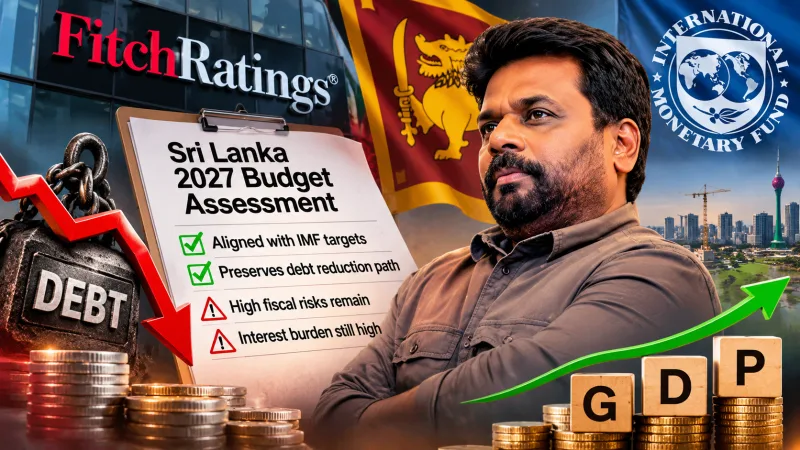
Fitch Ratings points out that Sri Lanka’s 2027 Budget is consistent with the fiscal targets agreed under the International Monetary Fund’s (IMF) Extended Fund Facility (EFF) and will support the continuation of the country’s debt-reduction path. However, this assessment does not guarantee that Sri Lanka’s economic risks have been eliminated. On the contrary, it also draws attention to the deep structural weaknesses that continue to exist within the country’s public finance system.
Fitch notes that the 2027 Budget provides an important basis for the seventh review, scheduled to take place before the current IMF programme concludes in March 2027, as well as discussions on a future programme. However, the question is not merely whether the Budget is consistent with IMF criteria. The more important question is whether the Budget can genuinely reduce Sri Lanka’s debt burden while creating new income, employment and investment opportunities within the economy.
The Debt Ratio Is Declining, But the Risks Have Not Disappeared
According to Fitch Ratings’ projections, Sri Lanka’s government debt, as a percentage of Gross Domestic Product (GDP), is expected to decline from 115% in 2022 to approximately 92% in 2026.
This represents significant progress in numerical terms. However, this figure remains considerably higher than the average of 55% for countries with a 'B' credit rating. Accordingly, although the debt ratio is declining, it is clear that Sri Lanka remains a country with a high level of debt risk.
Another point that deserves attention is the distinction between a declining debt ratio and the country's actual capacity to repay its debt. Only through economic growth, increased government revenue and the control of debt-servicing costs can the debt burden be brought down to a sustainable level over the long term. Therefore, a decline in the debt ratio alone cannot be considered a final indication of economic recovery.
41% of Government Revenue Goes to Interest Payments
The figure in the Fitch report that deserves the greatest attention is the share of government revenue spent on interest payments. Fitch states that nearly 80% of government revenue was spent on interest payments in 2023 and expects this figure to decline to approximately 41% in 2026. Although this represents a considerable reduction, it is still more than three times the median figure of 12.7% for countries in the 'B' category.
This figure reveals one of the major problems confronting Sri Lanka’s public finance system. When a substantial share of the money earned by the government through taxes and other revenue sources is spent on interest payments on existing debt, the amount remaining for investment in the country’s future development becomes limited.
Under such circumstances, the ability to increase public investment in education, healthcare, transport, agriculture, industrial development and new technology comes under pressure. At the same time, the fiscal space available to maintain public services and provide relief to the people may also become restricted.
Therefore, to understand the true scale of the debt crisis, it is necessary to examine not only the debt-to-GDP ratio but also how much of government revenue is being spent on interest payments.
Progress in Revenue Collection and Its Limitations
The performance demonstrated by Sri Lanka Customs in government revenue collection is another important element of this economic picture. According to official Customs data, Sri Lanka Customs has managed to collect more than 59% of its revenue target for November within the first 16 days of the month. Having exceeded its revenue targets for ten consecutive months up to October, the country is also reported to be on course to generate total Customs revenue exceeding Rs. 2,700 billion in 2026.
This is a positive signal in terms of government revenue management. However, achieving revenue targets and expanding the productive capacity of the economy are two different tasks. Although the government can generate revenue through increased taxes based on imports, long-term economic strength is built on domestic production, exports, technological innovation and higher productivity. Therefore, it is essential to make the success of revenue collection part of a broader economic transformation.
The Need for Government Borrowing Remains High
The Treasury bill auction also provides another indication of the government's fiscal requirements. According to the reported figures, Rs. 80.19 billion worth of Treasury bills was accepted at an auction in which Rs. 90 billion worth of Treasury bills was offered. The yields on three-month bills stood at 9.35%, six-month bills at 9.43%, and twelve-month bills at 9.95%.
Although Treasury bills enable the government to meet its short-term financing requirements, the cost of issuing them and the need to refinance debt when it matures also affect public financial management. Therefore, while a debt-reduction policy is being implemented, it is important to explain transparently why the government continues to require borrowing and for what purposes the funds obtained through such borrowing are being used.
Confidence in the Financial System and Market Signals
The Financial Intelligence Unit (FIU) of the Central Bank has revealed that administrative fines amounting to Rs. 3.3 million were imposed on two reporting institutions during the second quarter of 2026 for violations of laws relating to the prevention of money laundering and the suppression of terrorist financing. Such regulatory measures are important in maintaining the credibility of the financial system and the standards required for international financial transactions.
Meanwhile, according to the reported market data, the rupee's interbank spot exchange rate against the US dollar stood at Rs. 332.73–332.80, while the All Share Price Index (ASPI) declined by 298.31 points, or 1.37%, to close at 21,402.76 points. The S&P SL20 Index also declined by 1.46%.
Although movements in the market on a single day do not determine the long-term condition of the economy, it is important to examine them in the context of the broader picture involving investor confidence, interest rates, government debt management and economic expectations.
Sri Lanka Needs Not Just Debt Control, But Economic Transformation
The main policy message emerging from the Fitch Ratings report is that although Sri Lanka has made some progress along the path of debt reduction, that progress is still insufficient to eliminate the country's economic risks.
The fundamental objectives of an IMF programme are to establish fiscal discipline, increase revenue, ensure debt sustainability and build economic stability. However, the next challenge a country faces after achieving these targets is to transform that stability into a productive economy.
Sri Lanka needs more than a budget that increases tax revenue and controls expenditure. It needs an economic strategy that attracts domestic and foreign investment, expands export earnings, increases productivity in industry and agriculture, and creates quality employment opportunities for the younger generation.
Furthermore, when determining public expenditure priorities, long-term economic benefits must take precedence over short-term political requirements. If development investment continues to be restricted in the name of reducing debt, the country's capacity to generate future revenue could also weaken.
Therefore, the success of the 2027 Budget should not be determined solely by whether it meets IMF criteria. It must also be assessed in terms of how far the country's productive capacity, investment, employment, people's incomes and living standards improve alongside the reduction of the debt burden.
Debt reduction is an initial condition for economic recovery, not the final achievement. What Sri Lanka needs now is not merely to become a state capable of repaying its debts, but to build a productive and competitive economy that delivers benefits to its people and prevents the recurrence of debt crises.